
Practice: Zero Conditional
Harry Potter and the Philosopher's Stone — Book 1
Instructions:
Complete each sentence using
zero conditional only.
Use if + present simple, present simple.
All of these describe general rules, facts, or habits in the story —
not one-time future events.
🟢 ZERO CONDITIONAL
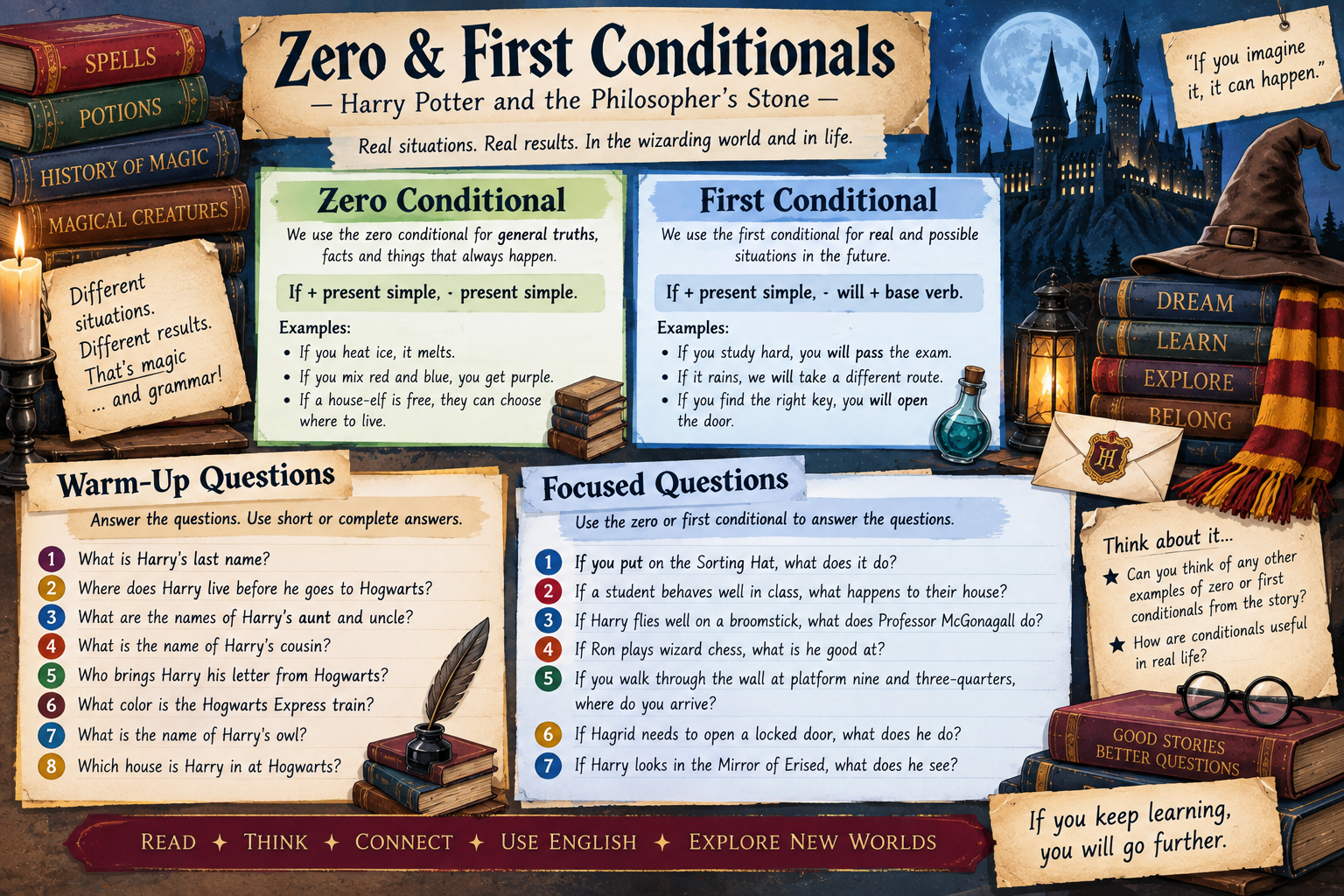
We use the zero conditional for general truths,
facts, rules, habits, and things that normally or always happen.
If + PRESENT SIMPLE → PRESENT SIMPLE
1
If Harry
(say) "Wingardium Leviosa" correctly, the feather
(rise).
2
If a student
(break) a school rule, Hogwarts
(take) points away.
3
If you
(mix) the wrong potion ingredients, the potion usually
(explode).
4
If Fluffy
(hear) music, he
(fall) asleep.
5
If the Sorting Hat
(place) a student in Slytherin, that student usually
(want) to prove themselves.
6
If Hagrid
(get) angry, strange things sometimes
(happen) around him.
7
If a wizard
(touch) the wrong tile in Devil's Snare, the plant
(grip) them tighter.
8
If you
(walk) into the Forbidden Forest at night, you usually
(find) dangerous creatures.
9
If Snape
(dislike) a student, he
(treat) them unfairly.
10
If Hermione
(study) hard, she usually
(get) the answer right.
11
If you
(look) into the Mirror of Erised, you
(see) your deepest wish.
12
If Filch
(catch) students out of bed, he
(report) them to a teacher.
13
If Ron
(play) wizard chess, he usually
(think) several moves ahead.
14
If a student
(perform) well in class, teachers usually
(praise) them.
15
If you
(insult) one of Hagrid's creatures, he usually
(get) upset.
16
If a wizard
(say) Voldemort's name, most people
(feel) afraid.
17
If Harry
(wear) the Invisibility Cloak, nobody
(see) him.
18
If Neville
(forget) a spell, his classmates sometimes
(laugh) at him.
19
If the trio
(break) too many school rules, they
(risk) losing house points.
20
If Dumbledore
(trust) someone, that person usually
(deserve) it.
FIRST CONDITIONAL
Harry Potter and the Philosopher's Stone — Book 1
Instructions:
Complete each sentence using the
first conditional.
Remember:
if + present simple → will + base verb.
These sentences describe real or possible situations and their
possible future results.
🔵 FIRST CONDITIONAL
We use the first conditional for real or possible situations
in the present or future and their likely consequences.
IF + PRESENT SIMPLE → WILL + BASE VERB
1
If Harry
(not stop) Quirrell, Voldemort
(become) powerful again.
2
If the trio
(not solve) the potion riddle, they
(not reach) the Stone in time.
3
If Ron
(help) Harry with the chess game, they probably
(win).
4
If Hermione
(remember) that Devil's Snare hates light, they
(escape) it.
5
If Neville
(tell) a teacher about the danger, the teacher perhaps
(not believe) him.
6
If Harry
(catch) the Golden Snitch, Gryffindor
(win) the match.
7
If Draco
(challenge) Harry to a duel, Harry
(accept), even though it's a trap.
8
If Voldemort
(get) the Philosopher's Stone, he
(return) to full strength.
9
If Harry
(not have) his mother's protection, Quirrell's touch
(hurt) him badly.
10
If Hagrid
(find) out who is after the Stone, he
(warn) Dumbledore.
11
If Harry
(win) the House Cup for Gryffindor, the whole house
(celebrate).
12
If the professors
(discover) the trio out of bed, they
(punish) them.
13
If Harry
(ask) Dumbledore for help, Dumbledore probably
(give) him only a hint.
14
If Hagrid
(raise) a dragon at home, someone
(notice) eventually.
15
If Filch
(see) the trio near the third-floor corridor, he
(report) them at once.
16
If Harry
(look) into the Mirror of Erised again, he probably
(want) to stay there forever.
17
If the trio
(not work) together, they
(fail) one of the challenges.
18
If Snape
(referee) a Quidditch match, Harry
(feel) nervous.
19
If Fluffy
(wake) up before they cross the trapdoor, the group
(be) in danger.
20
If Harry
(survive) his first year, he
(return) to Hogwarts next September.