
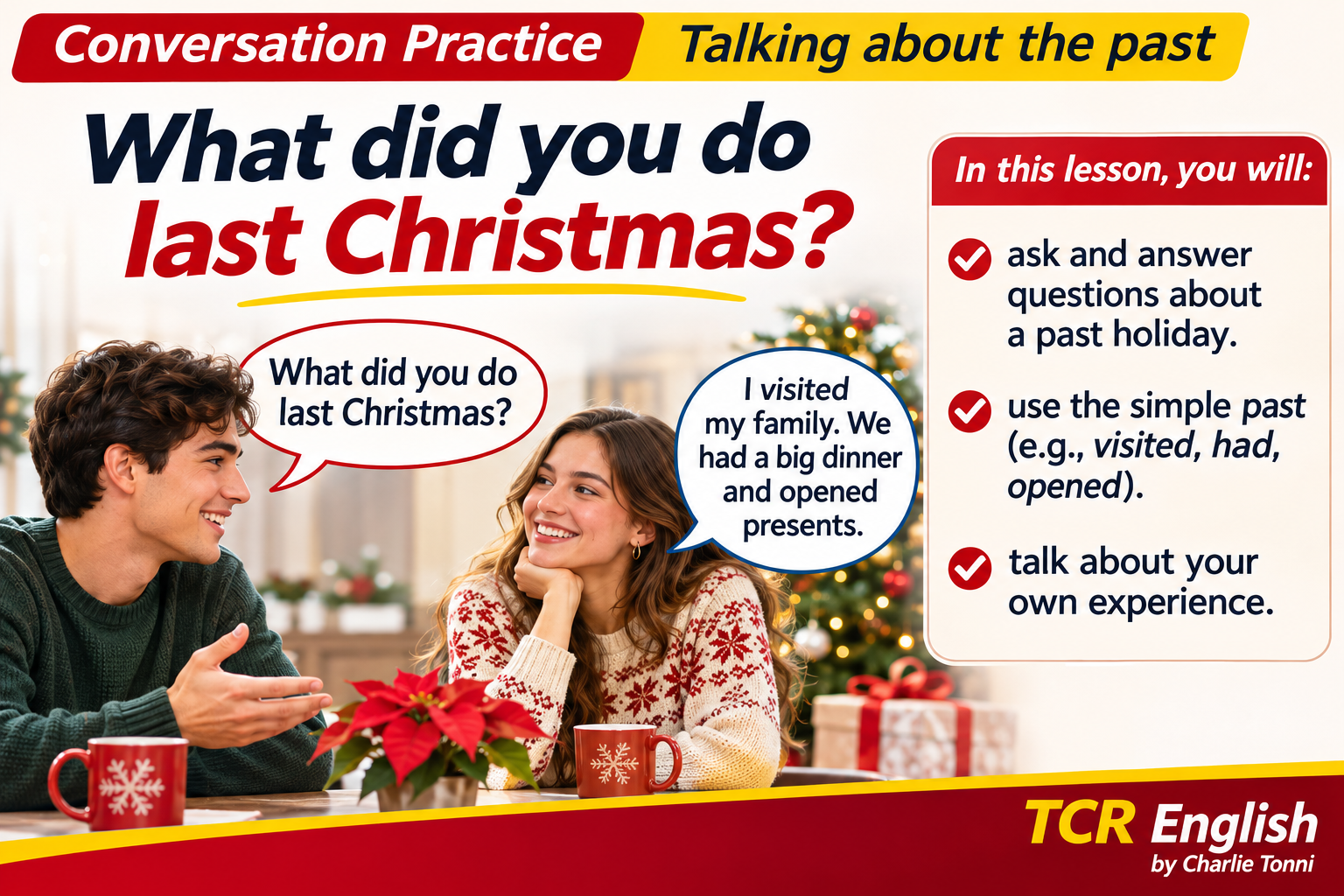
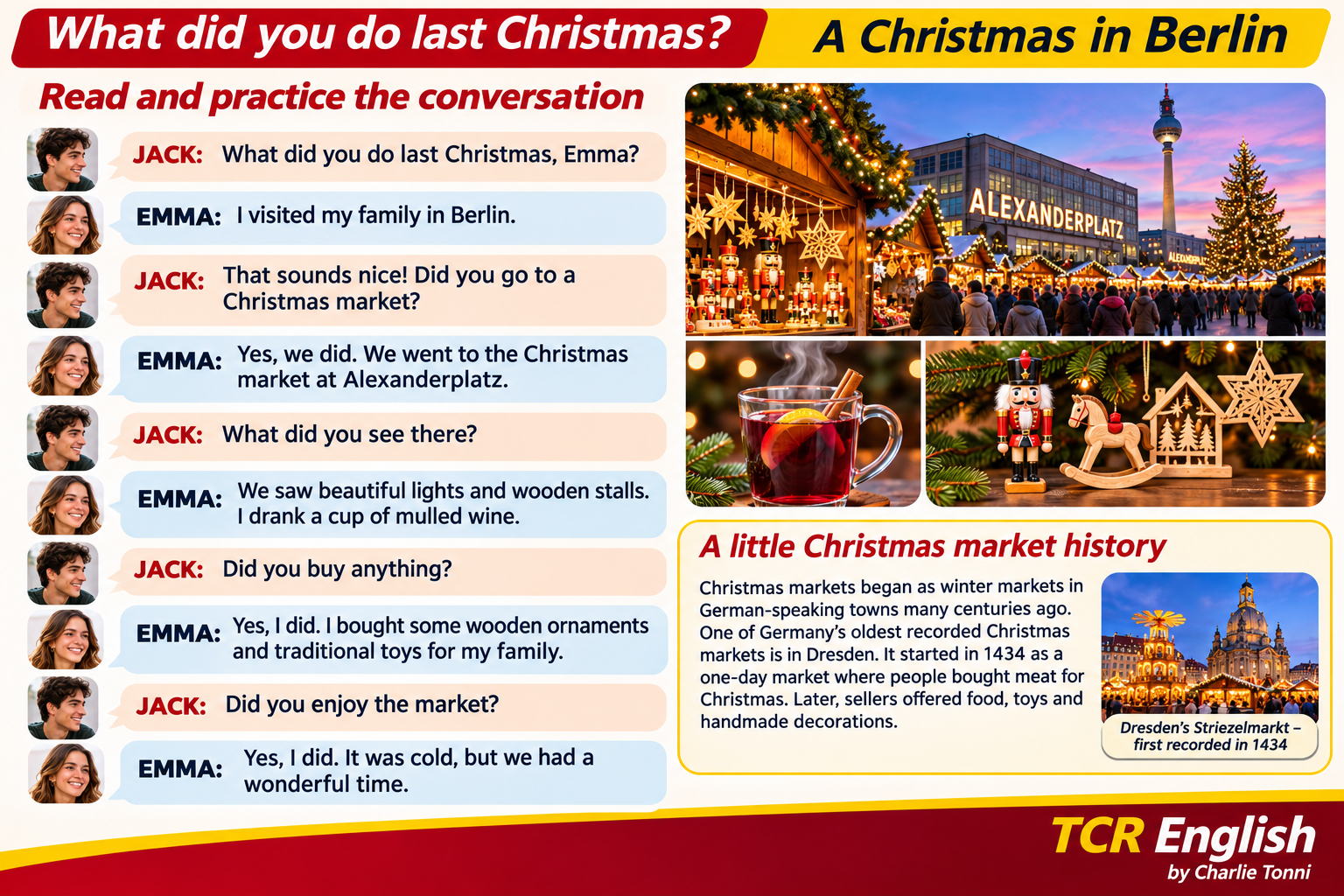
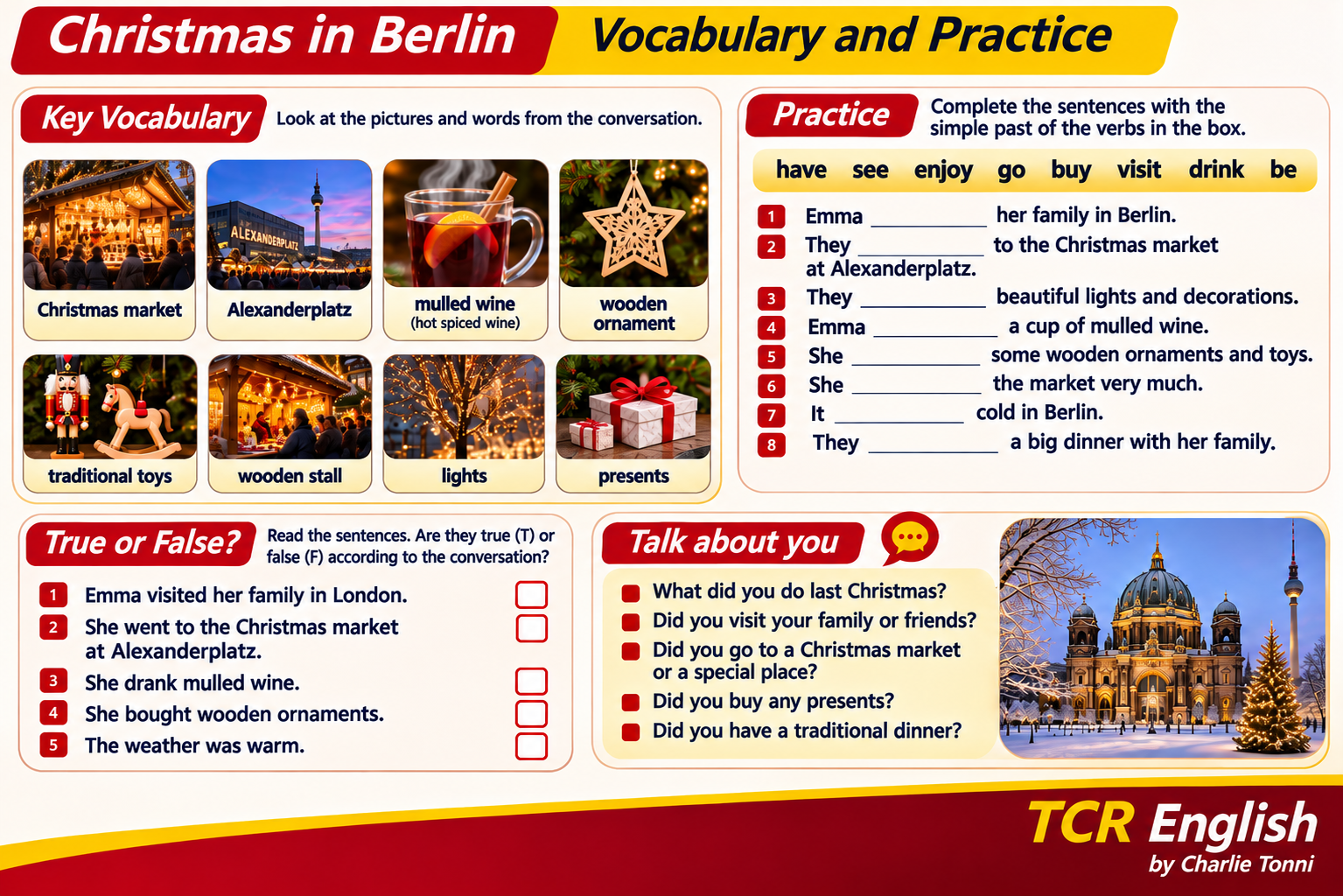
Christmas in Berlin

Simple Past: Positive, Negative & Questions

Vocabulary, pronunciation and grammar practice

🔊
Listen, repeat and practice. Learn the vocabulary of Christmas markets and use the simple past to talk about your Christmas experiences. All pronunciation targets are in American English.
0.90×
Ready. Click a speaker to hear a word or phrase.
1

Christmas vocabulary

Listen to each word. Notice its pronunciation and repeat it.

Christmas market
/ˈkrɪsməs ˌmɑrkɪt/
A seasonal outdoor market
Alexanderplatz
/ˌælɪɡˈzændɚˌplɑts/
A famous square in Berlin
Mulled wine
/ˌmʌld ˈwaɪn/
Hot, spiced wine
Wooden ornament
/ˈwʊdən ˈɔrnəmənt/
A decoration made of wood
Traditional toys
/trəˈdɪʃənəl tɔɪz/
Classic toys from the past
Wooden stall
/ˈwʊdən stɔl/
A small wooden shop
Lights
/laɪts/
Decorative lights
Presents
/ˈprezənts/
Gifts for other people
Decoration
/ˌdekəˈreɪʃən/
Something used to decorate
Christmas tree
/ˈkrɪsməs triː/
A decorated tree
Family dinner
/ˈfæməli ˈdɪnɚ/
A meal with your family
Wonderful
/ˈwʌndɚfəl/
Very good or enjoyable
2

Useful Christmas phrases

Listen to the complete phrases and repeat them.

I visited my family in Berlin.
/aɪ ˈvɪzɪtɪd maɪ ˈfæməli ɪn bɚˈlɪn/
We went to the Christmas market.
/wi wɛnt tə ðə ˈkrɪsməs ˌmɑrkɪt/
We saw beautiful lights.
/wi sɔ ˈbjuːtəfəl laɪts/
I drank a cup of mulled wine.
/aɪ dræŋk ə kʌp əv ˌmʌld ˈwaɪn/
I bought some wooden ornaments.
/aɪ bɔt səm ˈwʊdən ˈɔrnəmənts/
We had a wonderful time.
/wi hæd ə ˈwʌndɚfəl taɪm/
The weather was cold.
/ðə ˈwɛðɚ wəz koʊld/
I enjoyed the Christmas market.
/aɪ ɪnˈdʒɔɪd ðə ˈkrɪsməs ˌmɑrkɪt/
We spent Christmas with our family.
/wi spɛnt ˈkrɪsməs wɪð aʊɚ ˈfæməli/
Did you buy any presents?
/ˈdɪdʒə baɪ ˈɛni ˈprɛzənts/
Pronunciation tip: Regular past verbs ending in -ed have three common pronunciations: /t/, /d/ and /ɪd/. For example: watched /t/, enjoyed /d/, and visited /ɪd/.
3

Grammar focus: The simple past

We use the simple past to talk about finished actions and experiences.

Positive (+)

Subject + past verb
I visited my family.
We went to Berlin.
Emma bought presents.

Negative (−)

Subject + didn't + base verb
I didn't visit Berlin.
We didn't go shopping.
Emma didn't buy toys.

Questions (?)

Did + subject + base verb?
Did you visit Berlin?
Did they go shopping?
Did Emma buy toys?
Remember: After didn't and did, always use the base form of the verb.

✓ I didn't go.
✗ I didn't went.

✓ Did you buy presents?
✗ Did you bought presents?
4

Let's practice!

Use the verb in brackets to complete each sentence. Remember the rules for positive, negative and interrogative forms.

A

Positive sentences

Complete the sentences with the simple past form of the verb.

1
Emma her family in Berlin. (visit)
2
We to Alexanderplatz. (go)
3
Emma some mulled wine. (drink)
4
They beautiful Christmas lights. (see)
5
I wooden ornaments. (buy)
6
We the Christmas market. (enjoy)
B

Negative sentences

Use didn't + the base form of the verb.

1
Emma to the cinema. (go)
2
We any plastic decorations. (buy)
3
They coffee at the market. (drink)
4
I my friends on Christmas Eve. (visit)
5
We in a hotel. (stay)
6
Emma her cousins that evening. (see)
C

Interrogative sentences

Use the subject and verb in brackets to form complete questions. Remember: Did + subject + base verb.

1
your family last Christmas? (you / visit)
2
any wooden ornaments? (Emma / buy)
3
to the Christmas market? (they / go)
4
mulled wine? (you / drink)
5
her Christmas holiday? (she / enjoy)
6
a wonderful time? (they / have)

Now, talk about your Christmas!

Answer these questions using the simple past. Try to give complete answers.

  • Where did you spend last Christmas?
  • Who did you spend it with?
  • Did you visit your family or friends?
  • Did you go to a Christmas market?
  • What did you eat and drink?
  • Did you buy any presents?
  • What did you enjoy the most?
  • Did you have a wonderful time?
TCR English

Christmas Markets in Germany

A journey through history, traditions and culture

▶
Video listening and Simple Past practice
Watch the documentary and complete the transcript with the missing past-tense verbs.
1

Watch the video

Listening task: Watch the video and listen carefully to the historical information. Use the transcript on the right to complete the missing verbs.

Video chapters

  • Origins and early history
  • Evolution of Christmas traditions
  • Economic challenges and changes
  • Modern challenges and Christmas markets today
  • Traditional food, drinks and the future
2

Complete the transcript

Read the transcript while watching the video. Complete the gaps with the correct past form of the verbs in brackets. There are 30 gaps. Pay attention to regular and irregular verbs.
CHAPTER 1 Origins and early history
0:10 The history of the German Christmas markets goes back to the Middle Ages. The first Christmas markets were already (mention) 600 years ago. 0:19 The oldest ones in Germany are in Bautzen, Nuremberg and Augsburg. At the very beginning, Christmas markets (be) organized near churches so people could go to church before or after visiting a Christmas market. 0:35 People also (stock) up on food and everyday items before winter. 0:42 Before winter time, people (buy) gloves, hats, wooden baskets, shoes and toys. 0:52 Right before Christmas Day, the meat vendors (start) offering products. People in the city had access to meat for Christmas. 1:01 There were some bakers selling baked goods, and the musicians (provide) entertainment.
CHAPTER 2 Evolution of traditions
1:11 In the past, Christmas markets (be) organized during Advent. 1:20 Apart from Advent Sundays, there wasn't a time for eating fatty foods and drinking alcohol. Even on December 24th in Germany, the most simple meal (be) served. 1:29 The real celebration (start) on the 25th, usually with a roasted goose or duck. 1:35 Nowadays, Christmas markets (fulfill) another need: the need for social gatherings. 1:44 This (start) already in the 17th and 18th centuries. 1:51 At that time, Christmas (become) more of a family celebration than a religious one. Even the decorations (change) over time. 2:00 Nativity sets, figures of saints and stars (be) replaced by non-Christian elements such as snowflakes, deer, Santa Clauses and snowmen. 2:07 After the First World War, the Christmas market (be) nearing its end.
CHAPTER 3 Economic challenges and shifts
2:16 Big department stores (open) and offered toys and other products. 2:25 People usually (buy) these products at Christmas markets, but department stores offered them at much cheaper prices. 2:33 In this case, Christmas markets (rapidly / lose) their economic importance. 2:42 Thankfully, vendors (start) selling more regional products. This was also the time when the first carousels and even cinemas (appear) at Christmas markets. 2:50 A visit to a Christmas market (become) an event, and this was what people wanted.
CHAPTER 4 Modern challenges and scale
2:59 Christmas markets (be) also closed during the Nazi period and the Second World War. 3:09 In 2020, Christmas markets (close) completely. In 2021, they (be) open with many restrictions. 3:17 This year was very particular because of the energy crisis in Germany. 3:26 Other than this, nothing really (stand) in the way of enjoying mulled wine, roasted almonds and fried potato pancakes. 3:33 This year in Germany, we have 2,500 different Christmas markets with 85 million visitors every year. Some of them (have) up to 300 different stalls.
CHAPTER 5 Food, drinks and the future
3:47 Christmas markets are extremely crowded, especially in the evening. 3:54 More cozy and smaller Christmas markets are becoming popular. For children, there are fairground rides in Frankfurt. I (count) at least five there. 4:04 There are plenty of traditional German street foods to try, like bratwurst and other specialties. 4:12 For adults, there are plenty of alcoholic beverages. My favorite is Feuerzangenbowle, but this is for sure not the only one. 4:21 There are also pancakes and winter specialties like raclette or fondue. 4:30 We also (see) incredible baked goods, like huge pretzels and many sweets. 4:38 There are regional specialties from Frankfurt and Nuremberg, including gingerbread. 4:47 You can also find Bavarian specialties. If you don't like German food, there are international vendors offering international food. 4:56 As you can see, the Christmas market (adapt) very rapidly over the centuries. 5:05 I am very curious to see what needs it is going to fulfill in the future.
Complete the gaps and click Check answers.